
Malani: Of Woman Born
Nalini Malani: Of Woman Born
Of Woman Born
Kiran Nadar Museum of Art
Magazzini del Sale n. 5, Venice
Collateral Event of the 61st International Art Exhibition – La Biennale di Venezia
9 May–22 November 2026
Entering the dim interior of the Magazzini del Sale, a 15th-century salt warehouse along the Zattere, felt briefly disorienting after the brightness outside. In contrast to the overstimulating presentations of the Biennale’s main pavilions, Nalini Malani’s Of Woman Born offered a different kind of experience: darker, slower and resistant to immediate visual consumption.
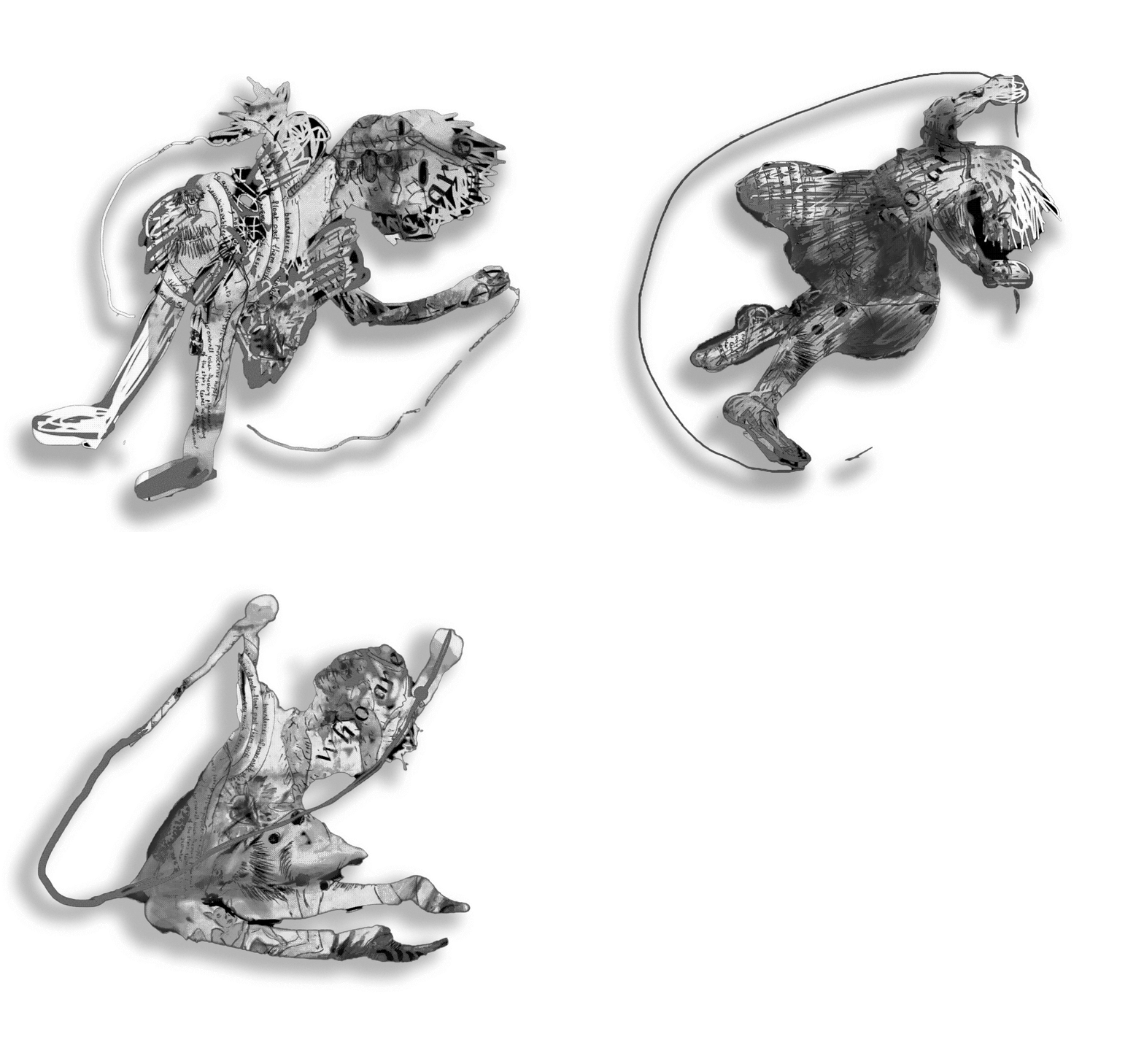
Presented by the Kiran Nadar Museum of Art as a Collateral Event of the Biennale 2026, the installation consists of 67 animated projections composed from more than 33,000 hand-drawn iPad drawings. The animations continuously appear, dissolve, overlap and reconfigure.
Drawing on the ancient Greek myth of Orestes and Adrienne Rich’s feminist text Of Woman Born, Malani examines patriarchal violence, war and the historical silencing of women’s voices. Throughout her five-decade practice, she has consistently challenged the assumption that intellect belongs exclusively to men, writing: “Thought is considered a male substance. If more attention were paid to the female thought process, perhaps we might reach something called progress.”
For Malani, the myth is not a historical remnant but a living structure that continues to shape the present. Throughout the installation, she foregrounds the displaced, those who mourn and those who remain largely absent from official histories of conflict.
The projections unfold in a loop lasting approximately 32 minutes and are accompanied by a layered 20-minute sound composition of quotations from writers and scholars, co-narrated by the artist herself. Voices overlap through the dark, cavernous interior, producing a sound that feels intimate and unstable.
A recurring figure throughout Malani's installation is the Skipping Girl, a character that has appeared across her work for decades. Fragile yet persistent, the Girl acts as both witness and survivor. The figure re-emerges through the projections and in posters installed across Venice during the Biennale, inviting audiences to “Join the Skipping Girl.”
What distinguishes Of Woman Born is not its scale or technological complexity, but the way it rejects a singular perspective. There’s neither a single vantage point nor a fixed narrative line. Images accumulate through superimposition, forcing viewers to navigate several visual streams all at once.
Malani’s animation process is equally significant. Each sequence is constructed through thousands of incremental drawings, producing an effect closer to stop-motion animation than seamless digital rendering. The emphasis is on drawing as an iterative act.
Malani refuses the sanitized visual language reinforced by contemporary digital aesthetics, which increasingly favour finish and resolution. Instead, her work moves toward a visual language that feels unstable and materially present. Fluids, secretions and stains recur through the projections. Trauma is not treated metaphorically, but as something that’s embedded in the body and resistant to erasure.
The layered animations and overlapping voices projected within the narrow chamber deny viewers the distance usually maintained between viewer and screen, transforming them from detached spectators into uneasy bystanders.The experience feels closer to sustained exposure than spectacle. Images dissolve before they can fully settle into focus, while voices accumulate faster than they can be individually processed. Malani surrounds viewers with a visual field of repetition and sensory overload.
The installation’s initial disorientation feels deliberate rather than incidental. Unlike immersive works that aim to captivate viewers through sensory pleasures, Malani’s work unsettles viewers, drawing them into participation. Neither the space nor the projections offer immediate visual resolution. Instead, viewers are required to readjust to an environment built through fragmentation and repetition. The bodily experience of the installation lingers long after viewers step back into the daylight.
MORE FROM ARTS & LABOUR:
- WOO Stories: Beyond Patterns
- Ruth Asawa: The Forms of Persistence
- WERK No. 35: The Value of the Unresolved
Kiran Nadar Museum of Art
Magazzini del Sale n. 5, Venice
Collateral Event of the 61st International Art Exhibition – La Biennale di Venezia
9 May–22 November 2026
Entering the dim interior of the Magazzini del Sale, a 15th-century salt warehouse along the Zattere, felt briefly disorienting after the brightness outside. In contrast to the overstimulating presentations of the Biennale’s main pavilions, Nalini Malani’s Of Woman Born offered a different kind of experience: darker, slower and resistant to immediate visual consumption.
Presented by the Kiran Nadar Museum of Art as a Collateral Event of the Biennale 2026, the installation consists of 67 animated projections composed from more than 33,000 hand-drawn iPad drawings. The animations continuously appear, dissolve, overlap and reconfigure.
Drawing on the ancient Greek myth of Orestes and Adrienne Rich’s feminist text Of Woman Born, Malani examines patriarchal violence, war and the historical silencing of women’s voices. Throughout her five-decade practice, she has consistently challenged the assumption that intellect belongs exclusively to men, writing: “Thought is considered a male substance. If more attention were paid to the female thought process, perhaps we might reach something called progress.”
For Malani, the myth is not a historical remnant but a living structure that continues to shape the present. Throughout the installation, she foregrounds the displaced, those who mourn and those who remain largely absent from official histories of conflict.
The projections unfold in a loop lasting approximately 32 minutes and are accompanied by a layered 20-minute sound composition of quotations from writers and scholars, co-narrated by the artist herself. Voices overlap through the dark, cavernous interior, producing a sound that feels intimate and unstable.
A recurring figure throughout Malani's installation is the Skipping Girl, a character that has appeared across her work for decades. Fragile yet persistent, the Girl acts as both witness and survivor. The figure re-emerges through the projections and in posters installed across Venice during the Biennale, inviting audiences to “Join the Skipping Girl.”
What distinguishes Of Woman Born is not its scale or technological complexity, but the way it rejects a singular perspective. There’s neither a single vantage point nor a fixed narrative line. Images accumulate through superimposition, forcing viewers to navigate several visual streams all at once.
Malani’s animation process is equally significant. Each sequence is constructed through thousands of incremental drawings, producing an effect closer to stop-motion animation than seamless digital rendering. The emphasis is on drawing as an iterative act.
Malani refuses the sanitized visual language reinforced by contemporary digital aesthetics, which increasingly favour finish and resolution. Instead, her work moves toward a visual language that feels unstable and materially present. Fluids, secretions and stains recur through the projections. Trauma is not treated metaphorically, but as something that’s embedded in the body and resistant to erasure.
The layered animations and overlapping voices projected within the narrow chamber deny viewers the distance usually maintained between viewer and screen, transforming them from detached spectators into uneasy bystanders.The experience feels closer to sustained exposure than spectacle. Images dissolve before they can fully settle into focus, while voices accumulate faster than they can be individually processed. Malani surrounds viewers with a visual field of repetition and sensory overload.
The installation’s initial disorientation feels deliberate rather than incidental. Unlike immersive works that aim to captivate viewers through sensory pleasures, Malani’s work unsettles viewers, drawing them into participation. Neither the space nor the projections offer immediate visual resolution. Instead, viewers are required to readjust to an environment built through fragmentation and repetition. The bodily experience of the installation lingers long after viewers step back into the daylight.
MORE FROM ARTS & LABOUR:
- WOO Stories: Beyond Patterns
- Ruth Asawa: The Forms of Persistence
- WERK No. 35: The Value of the Unresolved